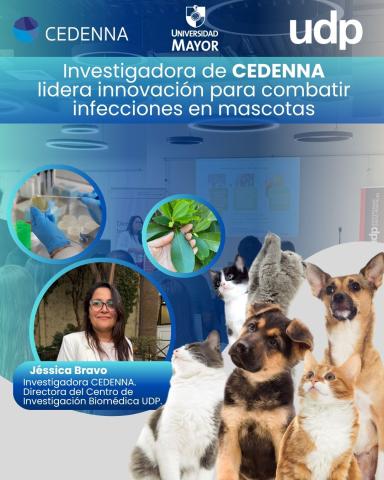
- More than three million dogs and cats are registered in Chile. In that context, a team of researchers associated with CEDENNA is working to ensure that science and nanotechnology also contribute to animal health care.
Pet ownership in Chile has grown steadily in recent years. Along with it, the health challenges associated with companion animals have also increased. One of the issues of greatest concern to veterinary medicine is antimicrobial resistance, particularly in recurring skin infections in dogs, where conventional treatments often depend on systemic or topical antibiotics.
In response to this scenario, a scientific team led by Dr. Jessica Bravo, a CEDENNA-associated researcher and director of Universidad Diego Portales’ Biomedical Research Center, is developing new topical formulations based on essential oils from native Chilean plants. The project, funded by ANID through the 2024 IDeA I+D competition, seeks to create safe, effective alternatives for treating canine pyoderma, a common bacterial skin infection.
“Antimicrobial resistance in companion animals is a public health problem that often goes unnoticed. When a dog doesn’t respond to the antibiotics available, the risk isn’t just to the animal, but also to the people who live with it,” says Dr. Bravo.
Canine pyoderma is a dermatological infection that can cause itching, redness, pus-filled lesions, scabs, hair loss, and skin inflammation. It is generally associated with underlying conditions such as allergies, parasites, or other skin disorders, and is one of the most common reasons for veterinary dermatology consultations.
The Chilean team’s proposal is to develop topical formulations based on essential oils from native species, with antibacterial activity against bacteria associated with canine pyoderma, especially Staphylococcus pseudintermedius. Unlike conventional antibiotics, these formulations aim to offer a local, naturally derived alternative backed by scientific evidence to support the management of skin infections in dogs.
Over the course of the project, the team has made progress in validating antibacterial activity in the lab, assessing safety in preclinical models, and conducting preliminary studies in dogs diagnosed with superficial pyoderma. These advances made it possible to complete the technical objectives committed to ANID and to consolidate a development platform with potential for technology transfer.
“We started from what Chile has: plants that grow in our territory and contain bioactive compounds of great interest. What we did was turn that knowledge into stable, safe topical formulations with real potential to reach the veterinary market,” explains the researcher.
The team’s next step is to incorporate nanotechnology tools, particularly nanoencapsulation strategies, which would help protect the bioactive compounds, improve their stability, and allow for lower product concentrations. This approach could make it easier to incorporate them into everyday formulations aimed at pets’ dermatological care.
Beyond the scientific development, the project includes a strategy for intellectual property protection and technology transfer. A patentability report concluded that the technology shows elements of novelty and inventive step under the criteria established by Chilean law, opening the possibility of moving toward a future patent application.
The initiative brings together the capabilities of Universidad Diego Portales, Universidad Mayor, the Bioactive Natural Products Laboratory, and CEDENNA, along with clinical support from COLMEVET, OFTADERM, and Universidad Mayor’s Teaching Veterinary Hospital. Botanical Solution, a Chilean company specializing in natural products, is also taking part as a potential licensee of the technology.
In an expanding veterinary market, developing innovative solutions for companion animals represents a scientific, health, and economic opportunity. The team’s goal is clear: to turn science based on native Chilean flora into a safe, transferable topical product with the potential to help manage skin infections in pets.