What can change when a magnet is shrunk down to nanometric dimensions? Much more than its size suggests. From sensors and spintronics to nanomedicine and space technologies, the design of magnetic nanostructures opens up new possibilities for research and application.
CEDENNA researcher and Universidad de Santiago de Chile academic Dr. Juan Escrig spoke about this work as a Keynote Speaker at NanoHorizons 2026, an international nanotechnology conference held in Peru and organized by the IEEE Nanotechnology Council Student Chapter of the Universidad de Ingenieria y Tecnologia (UTEC), with support from IEEE Region 9 for Latin America and the Caribbean.
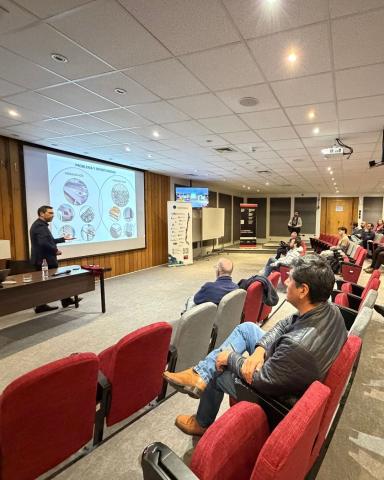
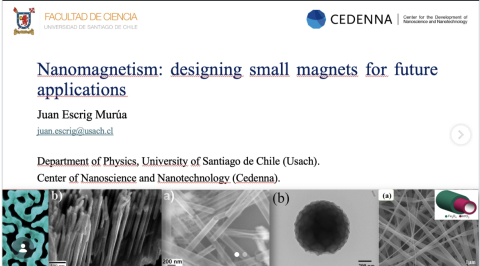
At the event, which he joined virtually, he gave the talk “Nanomagnetism: Designing Small Magnets for Future Applications,” addressing part of the research carried out at CEDENNA/USACH’s Nanomagnetism Laboratory.
One of the central aspects of his presentation was how it is possible to control the magnetic properties of extremely small materials through their design. At the nanometric scale, factors such as geometry, composition, surface effects, and confinement can alter the behavior of a magnetic structure, opening the door to developing materials with properties tailored for different uses.
The work carried out by Dr. Escrig and his team covers the design, modeling, fabrication, and characterization of magnetic nanostructures with complex geometries. Among the techniques used is atomic layer deposition (ALD), which allows structures to be coated with extremely thin layers and their characteristics controlled at the nanometric scale.
This research has applications in areas such as sensors, information storage and processing, spintronics, nanomedicine, and technologies designed to operate under demanding conditions, such as space applications.
The CEDENNA researcher’s participation took place in an activity specifically aimed at students and young researchers from the region, with the goal of introducing them to current lines of nanotechnology research and fostering Latin American scientific exchange.
“It will always be a privilege to contribute to training new generations and to keep strengthening scientific collaboration across Latin America,” he said, reflecting on his participation in NanoHorizons 2026.
August 11, 2026