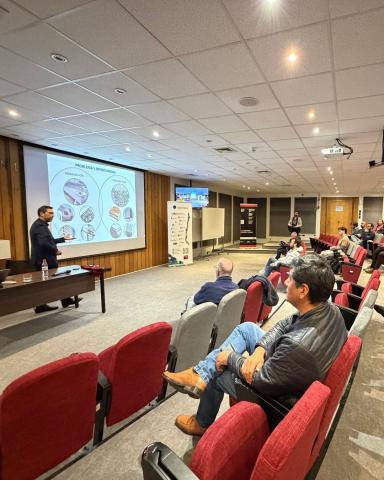
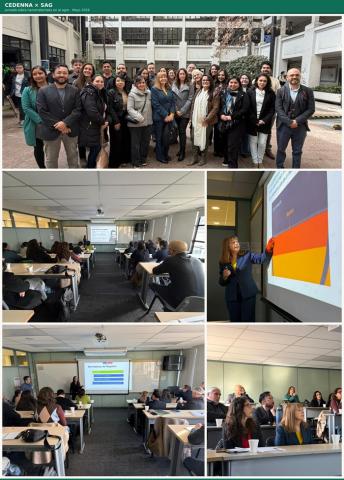
Following a technical workshop held on May 20 and a subsequent meeting with SAG’s National Director, the two institutions launched a joint work plan aimed at providing scientific evidence and technical capacity to help regulate agricultural products containing nanomaterials.
The Center for Nanoscience and Nanotechnology (CEDENNA) and Chile’s Agriculture and Livestock Service (SAG) began a technical collaboration process to address the challenges and opportunities posed by the use of nanomaterials in the Chilean agricultural sector, particularly in areas such as fertilizers, pesticides, veterinary medicines, and risk assessment.
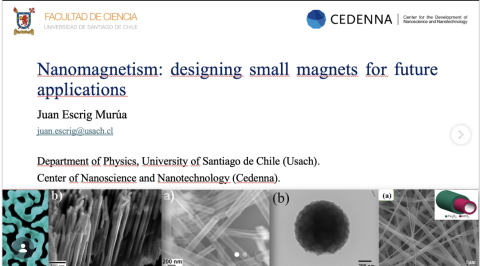
The first milestone in this partnership was a technical exchange workshop held on May 20, which brought together SAG professionals and CEDENNA researchers to share experience, review available capabilities, and examine the regulatory challenges associated with the safe use of nanoparticulate materials in agricultural products.
During the workshop, the teams addressed topics related to nanosafety, nanomaterial characterization, toxicity assessment, regulation of agricultural inputs, and possible areas for future collaboration. The meeting helped identify the need to advance technical criteria that support a more precise evaluation of products incorporating nanotechnology that may eventually need to be registered with SAG.
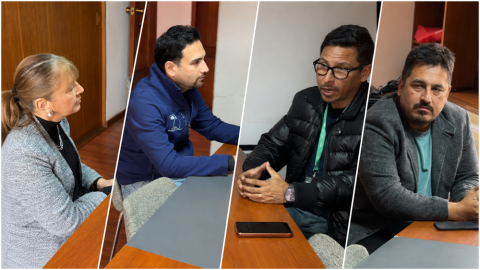
As a follow-up, a meeting was held on June 5 with SAG’s National Director, Domingo Rojas Philippi, attended by CEDENNA’s director, Dr. Dora Altbir, and lead researcher Dr. Mauricio Escudey. The goal was to move forward in defining a joint work plan regarding the regulations and technical criteria that agricultural products containing nanomaterials must meet at the time of registration.
This collaboration is especially significant in an international context where the use of nanomaterials across industries is advancing rapidly, demanding new capabilities in analysis, traceability, risk assessment, and regulation. For Chile, a country with a strong agricultural export focus, having its own criteria – grounded in scientific evidence and aligned with international standards – represents a strategic opportunity.
Applied science to support public regulation
For Lucia Valenzuela, Head of SAG’s Pesticide Authorization and Assessment Subdepartment, the workshop opened up a necessary technical conversation for facing new regulatory scenarios.
“This is a highly valuable opportunity for my team, because it helps us better understand nanoparticulate material and tackle the regulatory challenge it represents,” she said.
Along the same lines, Carlos Lecaros, a SAG professional, highlighted the value of having scientific information applied to the national context. “Collaborating with CEDENNA is extremely important for SAG because it allows us to get grounded information and draft regulations that are more coherent with our soils and our agriculture. These kinds of exchanges enrich us as an institution,” he stated.
Animal health was also part of the discussion. Carolina Marambio, Head of SAG’s Veterinary Medicines Registration and Control Subdepartment, underscored the importance of building links between academia and public services to anticipate technological challenges.
“Taking part in collaborative efforts between academia and our Service builds connections and lets us move forward on new technologies that can lead to solutions that improve animal health, with safe and effective products that support national production and the country’s export effort,” she noted.
Toward national nanosafety capabilities
One of the key points raised at the meeting was the importance of Chile strengthening its own capabilities to identify, characterize, and assess nanomaterials, rather than relying solely on criteria developed in other productive or regulatory contexts.
CEDENNA researcher Dr. Manuel Gacitua noted that this collaboration connects two fields that need to engage more deeply with one another: scientific knowledge generation and public regulation.
“There are two worlds meeting here: the academic-scientific world and the technical-regulatory world. And that combination simply has to work well together. Academia can offer new ideas, and SAG has new needs,” he said.
The researcher added that the country needs to move toward regulations suited to its own productive reality. “Let’s not wait for a standard from a developed country to arrive. We have our own land, our own agriculture, and our own needs. So we need to develop our own capabilities and regulations,” he stated.
CEDENNA’s capabilities at the service of the country
CEDENNA’s director, Dr. Dora Altbir, welcomed the start of this joint effort and stressed the importance of putting the Center’s capabilities at the service of public and productive challenges.
“This activity is the first step in a collaboration between SAG and CEDENNA to advance the safer use of nanoparticulate materials in the Chilean agricultural system,” she said.
CEDENNA has scientific and technological capabilities relevant to this challenge, including specialized laboratories, expertise in nanosafety and nanomaterial characterization, and a network of 57 researchers affiliated with 18 universities, spanning from the Arica and Parinacota Region to La Araucania.
Among its capabilities is the Nanobioassay Laboratory, which holds an assay accredited under the NCh-ISO/IEC 17025:2017 standard by Chile’s National Standardization Institute (INN) to assess nanomaterial toxicity under international OECD standards. This capability makes it possible to generate results that are traceable and internationally comparable, a particularly relevant feature given growing global regulatory demands.
CEDENNA is also a member of the OECD’s Working Party on Manufactured Nanomaterials, an international forum where standards, methodologies, and criteria for the regulation, analysis, and characterization of manufactured nanomaterials are discussed.
Transferring knowledge into public policy
The work now underway between CEDENNA and SAG represents a concrete opportunity to advance knowledge transfer from scientific research into public regulation. Its purpose is not only to open a channel for institutional collaboration, but to contribute to developing technical criteria that allow for a safe and responsible assessment of nanotechnologies incorporated into agricultural products.
In a landscape where technological innovation is advancing faster than regulatory frameworks, coordination between research centers and public services is key to anticipating risks, strengthening national capabilities, and supporting evidence-based decisions.
This collaboration points to an important line of work for the country: moving toward its own regulations and standards, suited to Chile’s agricultural reality and aligned with international best practices.
CEDENNA is the Center for Nanoscience and Nanotechnology, created in 2009 as an ANID Basal Center and hosted by Universidad Diego Portales. It brings together scientific capabilities from 18 universities across the country and carries out research, technology transfer, training, and specialized services in nanoscience, nanotechnology, and nanosafety.