April 27, 2026
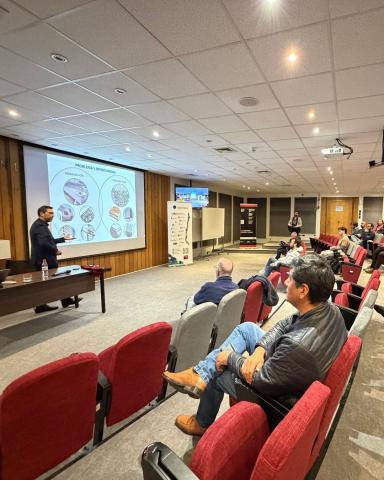
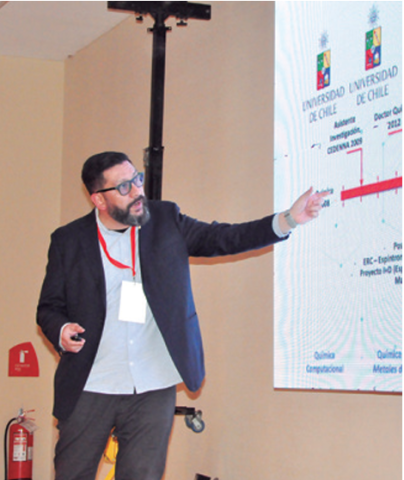
Dr. Walter Canon, a researcher at the Center for Nanoscience and Nanotechnology (CEDENNA) and an academic at Universidad Bernardo O’Higgins, took part in INTECMIN 2026, an event focused on innovation and technology for the mining industry, where he addressed the strategic role of rare earths in productive and technological development.
In his talk, titled “Rare Earths: From the Lab to the Market,” the researcher argued that the main challenge lies not in the availability of these elements, but in the complexity of their separation, purification, and industrial scale-up processes. These are materials with magnetic and luminescent properties that are key to electronic devices, displays, energy storage systems, and a wide range of technological applications.
Canon focused on the national landscape, explaining that Chile has potential not only in exploration, but also in making use of secondary sources such as tailings, clays, and electronic waste, opening a concrete path toward more sustainable mining. “Chile has a real opportunity to become part of the rare earth value chain, not only through extraction, but also through process innovation and the use of secondary sources, which makes it possible to move toward more circular and sustainable mining,” he said during his presentation.
The researcher also presented part of his scientific work, which includes the design of rare earth complexes with applications in molecular magnetism and luminescence, along with the development of multifunctional nanomaterials.
One of the most significant advances is a portable device for detecting rare earths in mining solids, developed in collaboration between Universidad Bernardo O’Higgins, Universidad Diego Portales, and CEDENNA. This technology aims to improve chemical and mineralogical characterization directly in the field, a key step in optimizing processes and reducing exploration costs.
Canon’s participation in INTECMIN 2026 reinforces the role of scientific research in developing solutions for the mining industry of the future, where efficiency, sustainability, and added value will be decisive factors.