
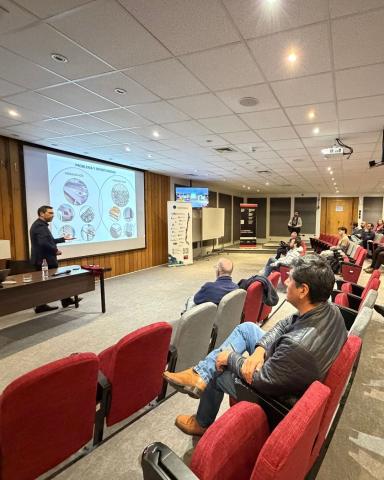
Dr. Roberto Lavin, director of the Institute of Basic Sciences at Universidad Diego Portales’ School of Engineering and Sciences, presented the successful results of two separate research projects carried out by CEDENNA researchers at a new session of the Cedenna Cycle seminar series.
The talk, titled “Nanotechnology in Construction Materials: From Microstructure to Macroscopic Performance in Wood and Concrete,” presented the results of studies carried out at UDP, including a FONDEF project and recent work aimed at improving concrete properties and functionalizing wood through ultrasound-assisted in situ synthesis processes.
Nanotechnology for concrete
Researchers at Universidad Diego Portales developed a concentrated nano-additive based on inorganic nanoparticles that is incorporated into concrete using the same processes currently used by the industry. The technology simultaneously improves the material’s mechanical, physical, and durability properties, increasing its strength while reducing water absorption, efflorescence, and porosity, without affecting conventional manufacturing processes.
The process also makes it possible to develop lightweight structural concretes with superior thermal performance, which would contribute to more energy-efficient buildings (with the resulting savings for their occupants) and more sustainable construction materials.
Nanotechnology for wood
In parallel, the team developed a technology based on the in situ synthesis of metallic nanoparticles within wood through an ultrasound-assisted, green chemistry process.
This innovation makes it possible to incorporate silver and copper nanoparticles into the wood’s structure, significantly improving its resistance to wear, fire, and ultraviolet radiation, while also providing antimicrobial protection. The treatment increased ignition time by up to 660%, reduced abrasion wear by between 39% and 44%, and increased stability under sun exposure, extending the wood’s service life without altering its internal structure. The technology opens up new possibilities for developing high-performance wood products for sustainable construction and outdoor applications.